Your cart is currently empty!

At Two Way Street, we’re passionate about creating environments where every person can communicate with confidence. A recent story from Claremont Special School really captures that spirit.
As part of an ongoing commitment to ensuring every student’s voice is heard and they have access to inclusive, multi-modal communication, each year Claremont Special School sends groups of staff to attend a 2 Day Introductory PODD workshop.
By attending these workshops, we hope that our staff return with stronger confidence, knowledge and practical skills to integrate AAC into their everyday interactions. Ultimately, it’s about empowering staff to use AAC more naturally and consistently, so that every student has more opportunities to communicate throughout the day.The consistent investment in learning has sparked a ripple effect that goes far beyond the classroom walls.
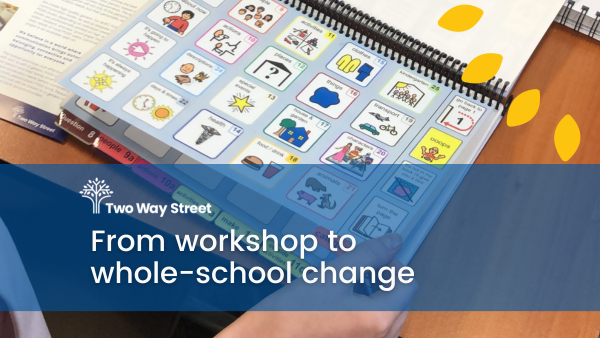
The Pragmatic Organisation Dynamic Display (PODD) system is one of the most widely used tools in the world of Augmentative and Alternative Communication (AAC). It supports people with communication disability to express themselves using symbols, words and visual layouts that promote natural and autonomous communication. For many attendees, these workshops offer ‘ahhaa’ moments in understanding how communication can be supported through natural interactions, modelling and everyday opportunities.
It was fascinating to learn the different ways and contexts in which the first two pages of PODD can be modelled! The quick chat pages have been a huge hit with all our staff and students. They’ve been a fantastic entry point for encouraging more spontaneous and meaningful communication.
Workshops like this don’t just build technical skills, they build confidence. When educators value multi-modal communication and see how AAC systems can support genuine conversations and participation, they start to model it more often and more naturally. And that’s where the transformation begins. It really does become the child’s voice.
Back at Claremont, the lessons from the Introductory PODD workshop didn’t end when the certificates were handed out. Staff began looking for practical ways to embed AAC and PODD communication books into everyday routines and environments.
For many years, the school’s goal has been to ensure that students have access to language across the school landscape, wherever they go. They rolled out communication boards across classrooms, playgrounds and in new buildings. But they didn’t stop there!
Recognising that communication inclusion involves the whole community, Claremont has worked to ensure that all staff, including teachers, administrative team members and support staff have their own PODD book (complete with strap to take it anywhere!). This simple yet powerful step ensures AAC is not confined to a classroom setting, but becomes a shared language across the school.
One of Claremont’s most successful initiatives has been the PODD Breakfast Club. The idea came directly from staff feedback and was designed to be a low-pressure environment, where staff support each other while practicing to use a PODD communication book over their morning cuppa.
It’s about empowering staff to use AAC naturally and more consistently, so that every student has more opportunities to communicate throughout the day.
This informal space has been key to building confidence and community. Staff report that it’s helped demystify AAC and made PODD use feel less complex and more achievable.
When asked how such initiatives impact school culture, staff have reported a positive communication and inclusion culture across the school. It’s created a positive buzz that Claremont endeavors to build on.
Since embedding AAC more intentionally across the school, Claremont has seen a clear shift in culture. The team explains:
We’re seeing an increase in communication across the whole school as staff feel more confidence using AAC and modelling PODD. It’s especially encouraging to see staff from across the whole school community embracing AAC as part of their everyday practice.
The result? A growing sense of empowerment and curiosity. Staff are asking more questions about how to support students’ voices and communication is becoming a natural part of every interaction, not an add-on.
When inclusive communication becomes a school-wide habit, it fosters connection, confidence and collaboration. It also models for students that communication can happen anywhere, with anyone, using multiple modes of spoken words, visuals, gestures or PODD books and AAC on devices.
Of course, creating a communication-accessible school hasn’t been without its challenges.
One of the biggest hurdles before the introduction of the PODD Breakfast Club was ensuring that all staff, including non-teaching and relief staff, felt confident and supported in using AAC when communicating around the school.
As the Claremont team describes “it’s not just about tool availability, but also about building confidence and supporting correct usage.”
This understanding is why they continue to prioritise hands-on practice, coaching and accessible professional development. The PODD Breakfast Club, targeted professional development sessions, and peer mentoring have all helped bridge this gap, creating a sense of shared learning and ownership.
In the everyday busyness of school life, it can be easy for new practices to fade, but Claremont has found ways to keep AAC front of mind.
When it comes to sustaining momentum, Claremont Special School believes that the need to provide space for ongoing practice and up-skilling in a low-pressured environment, as well as having AAC tools accessible in any environment is key.
The school also uses AAC Awareness Month as a time to celebrate communication, run fun activities and spark new engagement with students, families and staff.
These celebrations remind everyone that communication is everyone’s right and that AAC is for all communicators.
Looking ahead, Claremont plans to keep strengthening its multi-modal communication environment.
To support communication, Aided Language Displays’s are being added to more key areas of the school, such as lunch areas and bathrooms. They’re also gradually rolling out iPads with communication apps across classrooms to enable students to further express themselves. And importantly, they’re planning sessions with families providing the opportunity to learn more about AAC so that they can further support the communicative needs of their children.
When asked what advice they would give to other schools or professionals beginning their AAC journey, Claremont’s message is simple and powerful:
Don’t underestimate the importance of increasing knowledge and confidence – when you understand the “why”, the “how” becomes a lot easier! It’s okay to start small and build from there. Every step is a step in the right direction. Don’t forget to celebrate the simple successes!
At Two Way Street, we see firsthand how small, intentional steps can transform communication culture in schools, workplaces and communities. Claremont’s journey shows that when you invest in your people, through training, mentoring and consistent support, you create environments where every voice can be heard.
If you’re ready to start your AAC or PODD communication journey, we’d love to help. Whether you’re an educator, a speech pathologist or service provider, Two Way Street can support your team through:
Start your inclusive communication journey today:
👉 Explore workshops available by request from Two Way Street
👉 View communication tools available online
👉 Contact our team