
Take a look around your environment. Are you inclusive of communication modes other than speech?
We live in an era where we now expect to find assistive technology seamlessly integrated into public spaces. We look for the wheelchair ramp at the council chambers, the tactile ground surface indicators at the train station and closed captions on the gym television screen.
Physical accessibility has become a much more visible part of how we think about inclusive environments. Inclusive communication, however, is often missing from the places people need it most once they are up the ramp and through the door.
For many people, communication is still designed around one assumption: speech is the default. As a 2025 research article published in the Augmentative and Alternative Communication (AAC) Journal by Janice Light et al notes; limited communication opportunities aren’t an inevitable part of a person’s diagnoses, they are a direct result of a society that limits “meaningful opportunities to communicate and participate”.
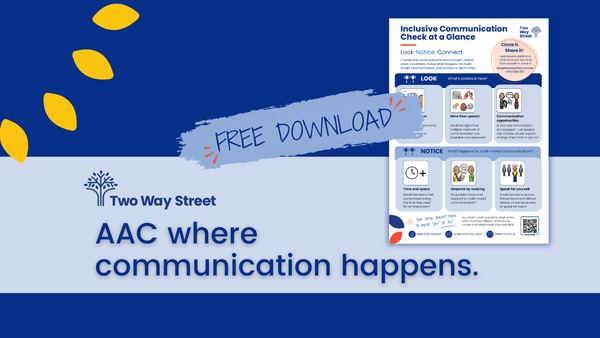
Take our Inclusive Communication Check At A Glance
Take a look at one environment, where people communicate every day, and notice where communication could be more accessible.
Speech is often the expected way to communicate and participate in many situations. When someone uses a communication method other than speech, they may be the ones expected to adapt rather than the environment adapting to multiple ways of communicating.
Communication doesn’t have to look or sound a particular way to be meaningful. And for people with communication disability, communication comes in many different modes. It could be speech, writing, gestures, facial expressions, signing, pictures, symbols, communication books and technology. AAC enables anyone to enhance their own communication and understanding of others through the use of all forms of communication with, or instead of, spoken language.
Communication disability is not one specific condition and it doesn’t look the same for everyone.
Speech Pathology Australia states that 1.2 million Australians reported some level of communication disability in 2015.
Communication disability can arise when the way someone communicates is not understood, supported or accessible in a particular setting. People may communicate in multiple ways for many reasons, including developmental, neurological, genetic or physical conditions, or differences in hearing, speech or language processing. A diagnosis alone does not tell us whether someone will face communication barriers. Those barriers may also change across settings, communication partners and stages of life.
AAC can offer more ways for someone to understand and express themselves. It can be used:
Experiencing communication barriers tells us nothing about a person’s intelligence, abilities or capacity to make their own choices.
This is where the social model of disability can change the way we think about inclusion.
Rather than viewing the disability as something associated with an individual, the social model draws attention to the barriers created by environments, systems, attitudes and social expectations. Inaccessible environments can create barriers that limit participation.
For communication, this means instead of asking ‘how can we help this person communicate here?’, we can ask ‘what could we change about this environment so that it is more communication inclusive?’.
This is where universal design can help. Consider inclusive communication from the beginning, rather than assuming everyone will interact within an environment in the same way and adding individual adjustments later.
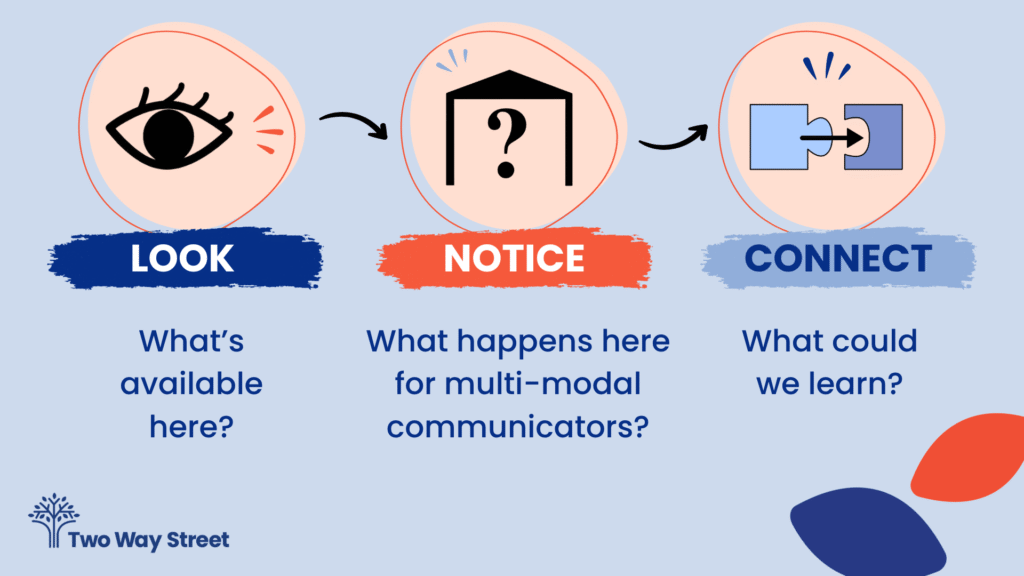
Choose somewhere people communicate every day.
It could be at home, in a classroom, workplace, reception area, recreation space, on public transport, at a cafe, health service or community centre.
Then look a little deeper. Ask yourself:
Think about the moment when people need to ask questions, express preferences, get someone’s attention, explain something, say no, change their mind, share an idea or simply join in.
Are there signs that other methods of communication might be available or welcomed ? Are people given the time they need to express themselves and respond?
And perhaps most importantly:
These questions aren’t assuming what a particular person needs or prefers. They’re encouraging curiosity about the environment and noticing where communication may be harder than it needs to be.
We’ve created a simple check to help you look at your environment and notice where communication could be more inclusive.
It’s a starting point: a way to identify what may be missing before considering inclusive communication solutions that reflect the people, the setting and the conversations they want to have.
And if you finish the check and are still thinking ‘I’m not sure’, that’s worth noticing too.
In a classroom
Where do students need to ask questions, express their preferences, get someone’s attention or join in?
In a workplace
Where do people need to interact with colleagues, customers or services?
In a community setting
What happens when someone needs to ask for more information, explain something or participate without using spoken language?
In a health service
Would someone be able to communicate without relying on another person to speak for them?
Start with curiosity.
Look. Notice. Then explore what meaningful communication support could look like.
When inclusive communication is considered from the beginning, in the places people learn, work, play, access services and connect with others, we create more opportunities for everyone.
The most useful first step isn’t always knowing what to change. It’s knowing what to notice. When we start with inclusive communication rather than waiting to respond to barriers, we create more belonging, autonomy, opportunity and connection for all.
Inclusion begins before arrival, continues during interaction, and extends beyond the visit. Together, we can move beyond compliance toward genuine inclusion by ensuring every person feels welcome, heard and able to participate meaningfully.
👉 Free scavenger hunt pack with aided language display
👉 Free bedtime chat aided language display
👉 See AAC in action with young AAC communicators
👉 Download our inclusive communication check at a glance
Communication isn’t something one person does to another. It’s an interaction between people.
It can be tempting to think that inclusive communication means having a communication resource available and the box is ticked. While communication resources can be useful, creating a communication inclusive environment involves more than the presence of resources.
We want to ensure that everyone can understand and be understood, in any way they communicate.
Inclusive communication depends on shared understanding. When staff have the time, training and support to slow down, speak directly with the person and use visual supports where helpful, communication resources can do what they’re there to do: help people understand and be understood.
So when communication doesn’t go as expected, curiosity can help. Ask yourself: ‘what might be getting in the way of communication here?’
Two Way Street works with businesses, schools, organisations and communities to make communication more inclusive in everyday environments.
We work with you to develop resources that suit your people and environment, and deliver training to ensure customer-facing teams are confident and competent in interacting when multiple modes of communication are used.
Get in touch.
Give us a call to find out more: 0434 266 237 or email [email protected]
👉 Explore resources designed to support communication in everyday environments.
Sign up to receive our eNewsletter. Hear from us about AAC, inclusive communication and practical ways to support communication in everyday environments.