Two Way Street Online
  • About
  • Solutions
  • Online learning & products
  • Workshops & events
  • Insights
  • Contact
  • Login
  • Search
  • Your cart is currently empty!
Your cart is currently empty!
  • About
    • What is AAC?
    • AAC User Lecture Series
    • Our team
  • Solutions
    • Individuals and families
    • AAC professional consultation
    • PODD service
    • Schools & Early Childhood
    • Communication Access
  • Workshops and events
    • Online learning & products
    • Insights
    • Contact
    • Login
  • Home
Blog article from workshop to whole-school change: a journey towards inclusive communication

At Two Way Street, we’re passionate about creating environments where every person can communicate with confidence. A recent story from Claremont Special School really captures that spirit.

As part of an ongoing commitment to ensuring every student’s voice is heard and they have access to inclusive, multi-modal communication, each year Claremont Special School sends groups of staff to attend a 2 Day Introductory PODD workshop.

By attending these workshops, we hope that our staff return with stronger confidence, knowledge and practical skills to integrate AAC into their everyday interactions. Ultimately, it’s about empowering staff to use AAC more naturally and consistently, so that every student has more opportunities to communicate throughout the day.The consistent investment in learning has sparked a ripple effect that goes far beyond the classroom walls.

Empowering educators through PODD training

The Pragmatic Organisation Dynamic Display (PODD) system is one of the most widely used tools in the world of Augmentative and Alternative Communication (AAC). It supports people with communication disability to express themselves using symbols, words and visual layouts that promote natural and autonomous communication. For many attendees, these workshops offer ‘ahhaa’ moments in understanding how communication can be supported through natural interactions, modelling and everyday opportunities.

It was fascinating to learn the different ways and contexts in which the first two pages of PODD can be modelled! The quick chat pages have been a huge hit with all our staff and students. They’ve been a fantastic entry point for encouraging more spontaneous and meaningful communication.


Workshops like this don’t just build technical skills, they build confidence. When educators value multi-modal communication and see how AAC systems can support genuine conversations and participation, they start to model it more often and more naturally. And that’s where the transformation begins. It really does become the child’s voice.

From workshops to whole-school practice

Back at Claremont, the lessons from the Introductory PODD workshop didn’t end when the certificates were handed out. Staff began looking for practical ways to embed AAC and PODD communication books into everyday routines and environments.

For many years, the school’s goal has been to ensure that students have access to language across the school landscape, wherever they go. They rolled out communication boards across classrooms, playgrounds and in new buildings. But they didn’t stop there!

Recognising that communication inclusion involves the whole community, Claremont has worked to ensure that all staff, including teachers, administrative team members and support staff have their own PODD book (complete with strap to take it anywhere!). This simple yet powerful step ensures AAC is not confined to a classroom setting, but becomes a shared language across the school.

The rise of the PODD Breakfast Club

One of Claremont’s most successful initiatives has been the PODD Breakfast Club. The idea came directly from staff feedback and was designed to be a low-pressure environment, where staff support each other while practicing to use a PODD communication book over their morning cuppa.

It’s about empowering staff to use AAC naturally and more consistently, so that every student has more opportunities to communicate throughout the day.

This informal space has been key to building confidence and community. Staff report that it’s helped demystify AAC and made PODD use feel less complex and more achievable.

When asked how such initiatives impact school culture, staff have reported a positive communication and inclusion culture across the school. It’s created a positive buzz that Claremont endeavors to build on.

A culture shift towards inclusive communication

Since embedding AAC more intentionally across the school, Claremont has seen a clear shift in culture. The team explains:

We’re seeing an increase in communication across the whole school as staff feel more confidence using AAC and modelling PODD. It’s especially encouraging to see staff from across the whole school community embracing AAC as part of their everyday practice.

The result? A growing sense of empowerment and curiosity. Staff are asking more questions about how to support students’ voices and communication is becoming a natural part of every interaction, not an add-on.

When inclusive communication becomes a school-wide habit, it fosters connection, confidence and collaboration. It also models for students that communication can happen anywhere, with anyone, using multiple modes of spoken words, visuals, gestures or PODD books and AAC on devices.

Overcoming challenges and building confidence

Of course, creating a communication-accessible school hasn’t been without its challenges.

One of the biggest hurdles before the introduction of the PODD Breakfast Club was ensuring that all staff, including non-teaching and relief staff, felt confident and supported in using AAC when communicating around the school.

As the Claremont team describes “it’s not just about tool availability, but also about building confidence and supporting correct usage.”

This understanding is why they continue to prioritise hands-on practice, coaching and accessible professional development. The PODD Breakfast Club, targeted professional development sessions, and peer mentoring have all helped bridge this gap, creating a sense of shared learning and ownership.

Keeping momentum alive

In the everyday busyness of school life, it can be easy for new practices to fade, but Claremont has found ways to keep AAC front of mind.

When it comes to sustaining momentum, Claremont Special School believes that the need to provide space for ongoing practice and up-skilling in a low-pressured environment, as well as having AAC tools accessible in any environment is key.

The school also uses AAC Awareness Month as a time to celebrate communication, run fun activities and spark new engagement with students, families and staff.

These celebrations remind everyone that communication is everyone’s right and that AAC is for all communicators.

What’s next for Claremont

Looking ahead, Claremont plans to keep strengthening its multi-modal communication environment.

To support communication, Aided Language Displays’s are being added to more key areas of the school, such as lunch areas and bathrooms. They’re also gradually rolling out iPads with communication apps across classrooms to enable students to further express themselves. And importantly, they’re planning sessions with families providing the opportunity to learn more about AAC so that they can further support the communicative needs of their children.

Advice for others starting their AAC journey

When asked what advice they would give to other schools or professionals beginning their AAC journey, Claremont’s message is simple and powerful:

Don’t underestimate the importance of increasing knowledge and confidence – when you understand the “why”, the “how” becomes a lot easier! It’s okay to start small and build from there. Every step is a step in the right direction. Don’t forget to celebrate the simple successes!

Inclusive communication starts with one step

At Two Way Street, we see firsthand how small, intentional steps can transform communication culture in schools, workplaces and communities. Claremont’s journey shows that when you invest in your people, through training, mentoring and consistent support, you create environments where every voice can be heard.

If you’re ready to start your AAC or PODD communication journey, we’d love to help. Whether you’re an educator, a speech pathologist or service provider, Two Way Street can support your team through:

  • PODD and AAC workshops for teams or individuals
  • Ready to go communication tools designed by experienced speech pathologists
  • Mentoring and coaching from our experienced team
  • Custom AAC implementation and school wide support to help you build inclusive communication into daily routines

Start your inclusive communication journey today:
👉 Explore workshops available by request from Two Way Street
👉 View communication tools available online
👉 Contact our team


  • Home
Inclusive Education insight article blog

What does inclusive education look like when you commit to including every child?

Building an inclusive learning environment is a commitment to recognising and addressing the diverse needs of every child. It also means creating an environment where all children feel welcome, valued and that they belong, without having to ask!

Being intentional in the set up of your learning environment will drive successful outcomes in engagement and positive behaviour. Children who experience an inclusive learning environment develop not only academically, but also socially and emotionally.

Just as inclusive architecture focuses on creating environments that are usable by all people – in education, resources and adjustments that may be a priority for some, can be used by all to enable opportunity.

These resources and adjustments encourage learning environments to:

  • provide information and content in various ways to accommodate diverse learning styles
  • offer various ways for students to engage with the content, which encourages motivation and interest
  • allow students to demonstrate their understanding in different ways, which recognises different strengths and preferences

When you minimise the barriers to learning and create an inclusive environment, ALL students are set up for success. This approach is particularly important in the early childhood setting, when needs may not yet have been identified and children are at different stages of development, with varying abilities.

Part of the equity and equality picture

There’s another buzzword you may have heard in education – Universal Design for Learning (UDL).

UDL guides the creation of learning outcomes, resources and assessments that work for everyone. While some children will need more individualised adjustments and tools to participate in an environment, UDL closes the gap that needs to be filled by an individual.

For example, height adjustable desks in a classroom mean that a child who uses a wheelchair some or all of the time, can still sit at the same desks and in the same space as all of the other children. In addition, taller children and smaller children can also set the desk to the height that best suits them rather than needing a cushion or having to sit at a different desk. These children ‘just fit’ in their classroom and there is no requirement to apply for extra funding, have special meetings to organise an appropriate desk, nor to encounter challenges when the class moves to a different room where the ‘special desk’ is not available. There may also be some days where all children would benefit from alternating between standing and sitting.

Communication is no different. Though the majority of children in our childcare and school settings communicate with spoken words, many need or prefer other methods such as sign, symbols, typing, body language and more. Many children benefit from alternate methods some of the time, or to enhance their expression or understanding through visual channels.

Just as PowerPoint, photos, maps and pictures add visual meaning and interest to our conversations and learning, visual displays can do the same for our children by expanding on the spoken word. All children can benefit from the inclusion of symbolic communication displays to enhance understanding, idea generation and expressive communication. With varied methods of communication available, those who need or prefer to use them will ‘just fit’ into their learning environment too. The communication displays also have a beneficial impact on those who may not speak English as a first language, may be shy, or as yet have not been identified as someone who may benefit from a personalised communication system.

It’s never one-size fits all, especially when we consider preferences

Remember that preferences are part of the equality equation and are an important component in creating your inclusive learning environment. Taking preferences into account is crucial because it acknowledges that children have different ways of processing information and engaging with their surroundings. And those preferences may change based on the activity or environment.

Considering preferences promotes a sense of autonomy and agency among children. When children have choices in how they learn and demonstrate their understanding, they are more likely to be actively engaged and invested in their learning process. It’s empowering to feel valued and supported when exploring your own unique interests and strengths!

As we aim to create an inclusive world that includes communication accessibility opportunities, we need to ensure that symbolic communication starts in the early years as a component of UDL (also referred to as Tier 1 support). We can not know which children may need or prefer to use symbols for communication later in life, nor those who benefit from the symbols to enhance their comprehension of speech. Rather than waiting to find out, let’s give opportunities early.

It’s better to be glad we did, than to regret we didn’t

Integrating symbolic communication into existing curricula can be done with a few simple adjustments. By incorporating visual aids alongside other forms of communication, all children will feel empowered to express themselves effectively. And as we mentioned earlier, embracing inclusive communication practices early, not only benefits people with specific needs, but fosters empathy and understanding among all children preparing them for a diverse and interconnected world.

At Two Way Street, we’ve started our quest to ensure that people see symbolic communication as ‘just part of it’ rather than it being different or special.

Our first Communication For All Pack is available now, for the Early Childhood setting. We’ve done all the work, so you can create a truly communication inclusive environment. The pack includes symbolic communication displays for common activities in kindy or childcare settings, along with posters that value, respect and represent symbolic communication, plus downloadable templates to help you implement inclusive communication practices.

Want to know more?

Take a closer look at the Communication For All Pack – Early Childhood. And get in touch with the team at Two Way Street for more information.

  • Home
Insight article life after school transition tips

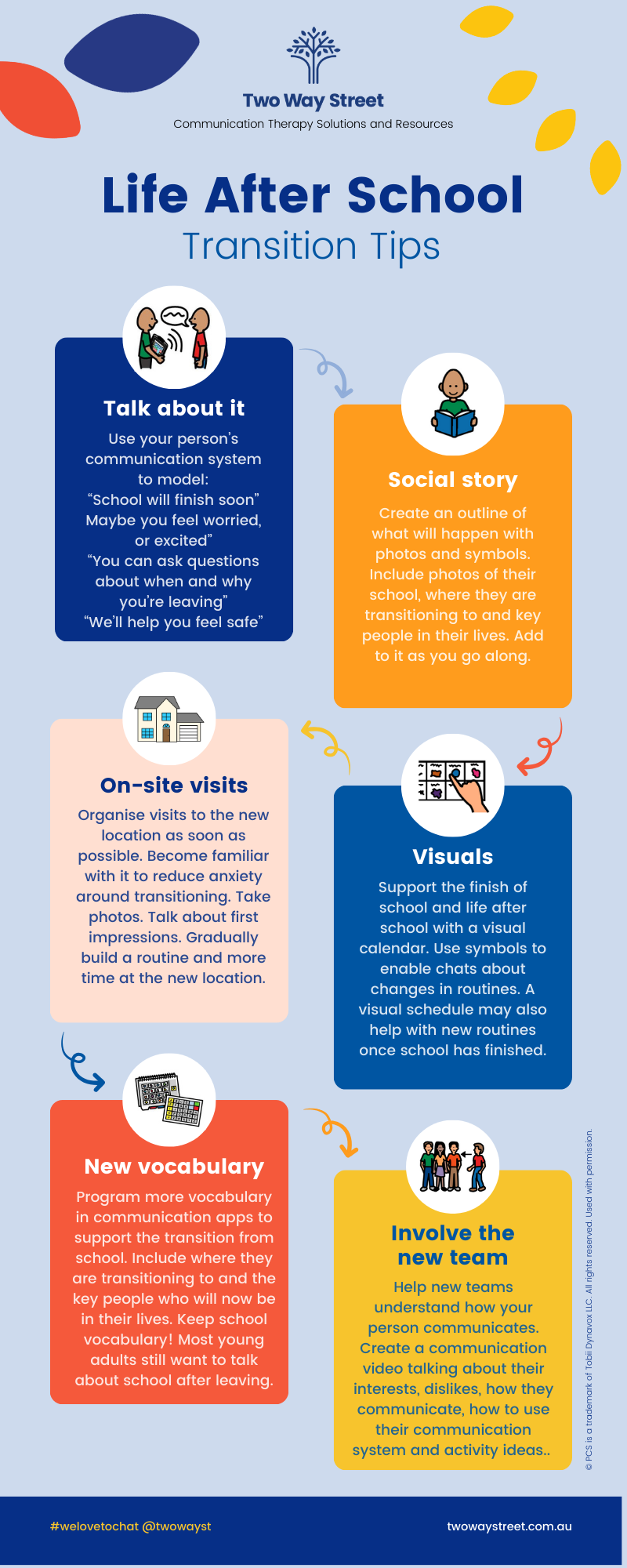
Transition tips

Most of us spend well over a decade of our younger lives at school. The transition from school to work, school to university – or to whatever life after school looks like – can be a tough one! And it becomes even more complex when you have a communication disability.

In this insight article, we share some strategies and ideas for you to help prepare your person to begin their new life after school, and be ready for whatever the future brings.

Talk about life after school

You don’t need to prepare anything for this, just talk as you normally would. If possible, use your person’s communication system to model the messages. Here are some ideas:

  • “At the end of the year you will leave school” or “soon school will finish”
  • “Maybe you feel worried, or excited. That’s ok, it’s a big change”
  • “You can ask questions like… When am I leaving? Who is coming with me? Why am I leaving school?”
  • “We will make sure you always feel safe”
  • “You can still see your friends from school after you leave”

Social story

Create a story using Microsoft Word or the Pictello App outlining what will happen. Use photos and symbols. It’s ok if you don’t have all of the answers when you first introduce the story, you can add to it as you go along. Try to include photos of the school, your person and the key people in their lives. If you know where your person is transitioning to, whether it be further education, work or something else, start introducing this.

On-site visits

When you know where your person will be transitioning to after they finish school, organise some on-site visits as early as possible. It is important that the new setting, whether it is another educational facility, a workplace or somewhere else, becomes a familiar place for your person, to reduce anxiety they may experience about leaving school. Take photos if you can. Ask your person their thoughts about the visits each time they go. Try to gradually work up your days at the new location, so your person has an opportunity to get used to their new routine after school has finished.

Visuals

A visual calendar is a great way to support the lead up to finishing school and the start of their life after school. This may help you to talk about changes in their routine with symbols. A visual schedule may also help your person with new morning or afternoon routines once school has finished.

New vocabulary

Leaving school is a big change, so it is important to give your person access to the vocabulary they need to talk about it. If your person uses a communication app as part of their overall communication, you can program additional vocabulary to support the transition from school. Include the name of the place they are transitioning to once they leave school and the key people that will be in their lives. You could also create a chat page about the transition from school and questions that your person may ask. Be careful not to erase their school vocabulary. Most young adults still want to talk about school after they have left.

Involve the new team

If your person is transitioning to a new place such as a workplace or day options program, it is important that their new team understand how they communicate. You, your person and/or your speech pathologist can create a communication video talking about:

  • What your person likes / doesn’t like (favourite footy team)
  • How your person communicates (voice, sign, body language, PODD book, iPad with Proloquo2Go)
  • How to use their communication system
  • General communication strategies
  • Activity ideas

These videos are an accessible and engaging way for others to get to know your person.

Connection with others

Once your person leaves school for the final time, find ways to stay connected and enable them to have conversations about their school experiences.

  • Ask their teacher or school principle to record a video message. They could say something like “Hi . We miss you here at school. We hope you are doing well. We would love to hear about what you’re up to now”.
  • Make a class photo easily accessible to your person so they can use this as a way to start an interaction about school.
  • Ask the teacher to connect your person with a pen pal. This doesn’t need to be writing letters to one another. Instead, your person could create a message on their communication system. You could record them sharing the message in a video and then send it to their “pen pal”.

Keep learning

Learning doesn’t stop with school! Your person will have the opportunity to consolidate skills they have learned at school and pick up new skills on their post-school journey. Using these strategies, your person will be better prepared for life after school and empowered to embrace whatever the future holds. This is a new chapter full of possibilities and with your support and the right tools, your person will continue to thrive and grow in their own unique way.

Is your person already a client with Two Way Street? Talk to your Speech Pathologist about creating resources to support the transition from school.

Written by: Erin Morley, Speech Pathologist
  • Home
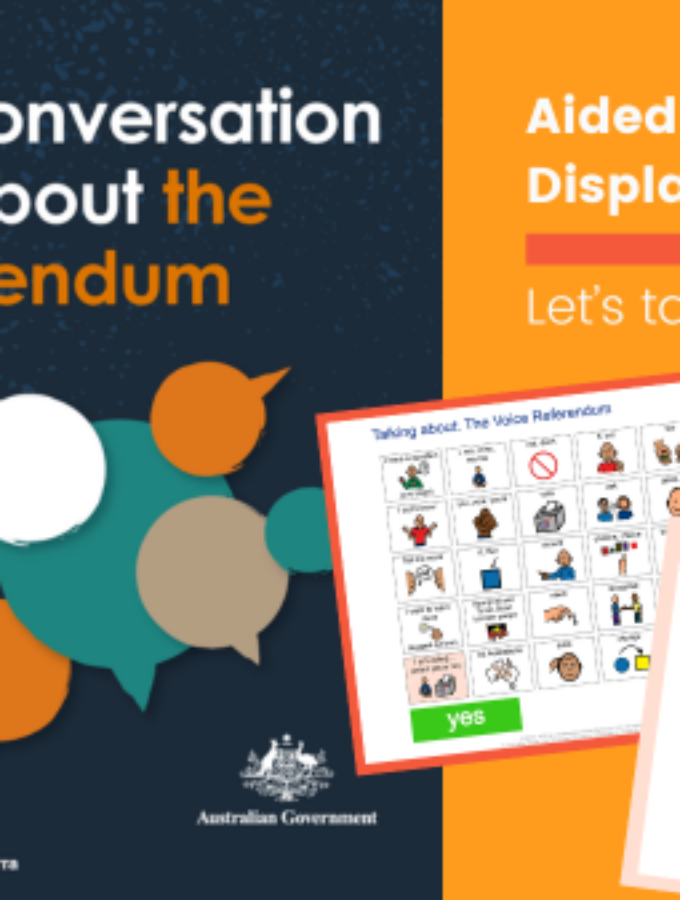
There's a conversation going on about the Voice referendum

On October 14th, the people of Australia will vote in a referendum. The question on the ballot paper is: “A Proposed Law: to alter the Constitution to recognise the First Peoples of Australia by establishing an Aboriginal and Torres Strait Islander Voice. Do you approve this proposed alteration?”

Vote yes or no in The Voice referendum

Voters will be asked to vote ‘yes’ or ‘no’ to this question.

At Two Way Street, we think it’s important that everyone has a voice. If you are over 18, then you are entitled to vote in the election. If you are under 18, then it’s still a very important topic of conversation. Not just for the outcome of this vote, but to consider and understand significant events occurring in our country and the world. This will help you to relate to information you might hear in the news or on social media, as well as to be part of conversations both in person and online about current events.

Voting is both a right and a privilege in Australia, as well as being compulsory for those over 18 (remember to enrol to vote if you haven’t already!). For those under 18, events like this referendum give us opportunities to talk about voting, laws and topics that help to build our understanding and capacity to make decisions, and to vote as an informed citizen after we turn 18.

Accessible resources for the Voice vote

The Australian government and others have created some accessible resources relating to this referendum. We’ve included links to these below.

We also think it’s important to provide opportunities for people to talk about the referendum, their reasons for voting ‘yes’ or ‘no’ and to ask questions before they make a decision. Good decisions include more than just being told information. Most people have conversations with friends, family, colleagues and even those who disagree with us in order to make decisions and prepare to vote.

To get the conversation started for people who use communication symbols to augment their communication, we have created a ‘Talking about The Voice’ aided language display (ALD). Of course there may be many more words required for a robust discussion on this referendum. This ALD is just to get the conversation started.
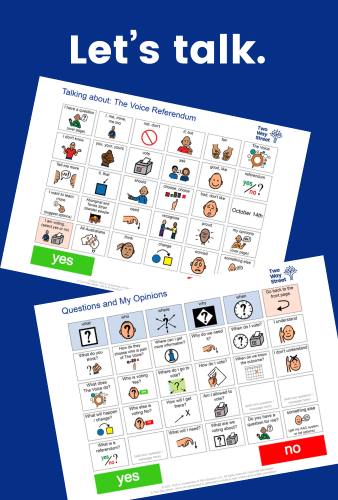
The Talking About The Voice ALD

Talking about the Voice to Parliament aided language display (ALD)

The first page has vocabulary to talk about the Voice and express opinions. The second page (reverse side) includes some common questions as well as space to add the individual’s own questions that they might like to ask people. We’ve also included some spaces to add personal opinions or preferences to share with others once you’ve had a chance to think about it. If you are a parent or support worker, be sure to only add messages that have been created by the person or at a minimum, agreed upon by them.

After these discussions, you might also like to add messages to the person’s own AAC system for use in all situations, or consider sharing information on social media, or by joining their selected campaign. It is crucial that you gain consent for any action you take on their behalf and that you keep your preferences separate from theirs when sharing their message.
Download ALD

Tips when talking about the Voice with the ALD

  • Point to (and/or read out) the messages on the board as you talk to the person, and give them opportunities to say things with the board too. They may not point to the messages but may use their body, voice or facial expression to show agreement or disagreement with your messages. Watch and listen to hear their opinions or questions.
  • If a person can’t point to the symbols, then read out the options and ask them to tell you ‘yes’ or ‘no’. When you get to the one they want to say, ask if they are finished or want to add another word, otherwise you might only get half of the message.
  • To speed things up, you might point to a column at a time first, then the individual messages.
  • Scan the QR code -> for an example of what that might look like.
  • It may help to take a photo of the ALD, so you have it handy at all times. You never know when the topic of the referendum will come up. (Maybe when you’re out for coffee, or visiting friends).
  • The Two Way Street talking about the Voice referendum ALD can be used to share information with a person who would benefit from symbols to aid their understanding, and/or it can be used by the person to ask questions or talk about the referendum and their decision.
  • Remember that voting is a personal decision and it’s important to respect each individual’s views. When you are talking about The Voice with someone who uses AAC, be very aware of your own personal preferences and try to avoid any bias or coercion.

Examples of phrases using the ALD

Giving information:

  • Start by reading the Easy English Fact Sheet this is a helpful way to share information to start the discussion.
  • You could also ask the person to point to a section of the fact sheet if they don’t understand.
  • You could say tell me more if you want more information.
  • Let’s talk about the referendum.
  • It’s on October 14, 2023
  • It’s about the Aboriginal and Torres Strait Islander Voice/ The Voice
  • You can vote. (Or You can’t (not) vote yet but we can talk about it).
  • You can vote Yes or you can vote No.
  • It’s your choice.
  • (I have a question) What do you know about it?
  • (I have a question) Do you have any questions for me?

Talking about the referendum:

  • You tell me more and point to the Easy English Fact Sheet or any documents or websites you’ve been looking at.
  • I want to learn more (communication partner to offer options for the ways the person could do that such as watch, listen, read, talk with others).
  • (I have a question) Why do we need it?
  • (I have a question) What do you think?
  • (I have a question) What will happen if yes/no?
  • I don’t know.
  • Tell me more.
  • I choose/think/vote Yes
  • I choose/think/vote No
  • That’s not fair.
  • That’s fair.
  • Me too. (to agree with something someone else said)
  • I heard/think it’s good/not good for All Australians
  • I heard/think it’s good/not good for Aboriginal and Torres Strait Islander people.
  • I heard/think it’s good/not good for people who are not Aboriginal and Torres Strait Islander people.
  • We (all Australians) should vote yes/no.
  • We don’t need The Voice to recognise Aboriginal and Torres Strait Islander people.
  • We need The Voice to recognise Aboriginal and Torres Strait Islander people.
  • I feel proud of Australia because of this vote.
  • I am worried for Australia because of this vote.
  • We (you and me) should ask some other people what they think (I have a question) What do you think?

Enjoy the conversations and we look forward to a referendum where everyone has a voice about the Voice!

Other information sources

The Voice website, includes:

  • a fact sheet written in an easy to read way with pictures to explain ideas
  • videos in Auslan under ‘translated resources’
  • First Nations toolkit featuring a Conversation Guide
  • resources in languages other than english under ‘translated resources’

Visit the Australian Electoral Commission for more accessible resources and information on enrolment and voting.

Civics Australia also provides information about the referendum in an engaging way.
  • Home
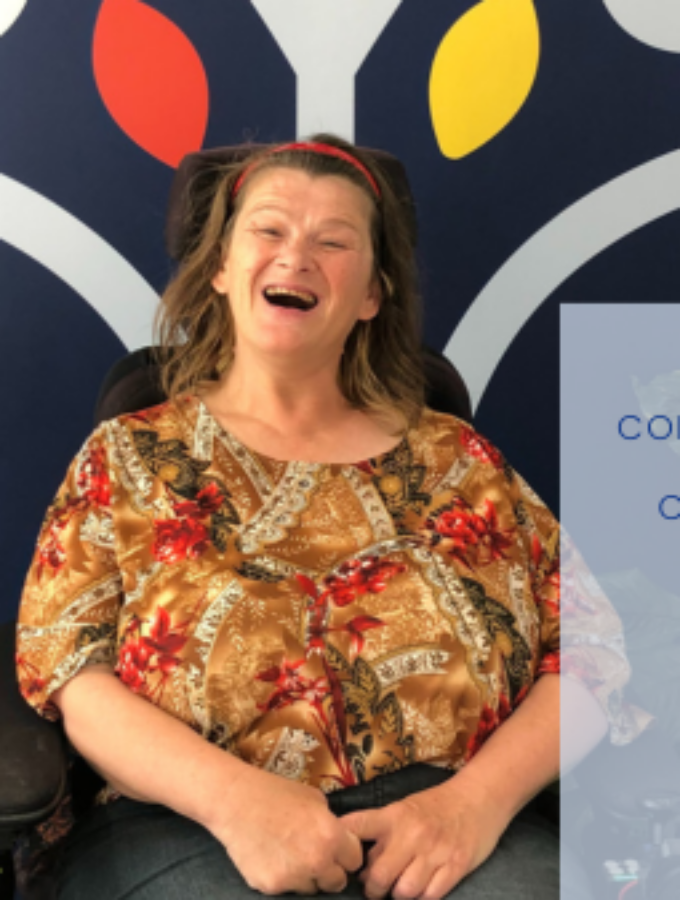
Margie Charlesworth, Communication Access Consultant. Finding my voice.

By Margie Charlesworth

I was born with Cerebral Palsy and grew up using my natural speech with what I like to call a ‘Cerebral Palsy accent’ (some of you may call this a communication disability). It was an era when talking freely about emotions just didn’t occur. Limited options for speech generating devices made it difficult for me to communicate effectively, and when I did try to express my feelings, the outcomes were often disastrous for me and those around me.

My parents did the best they could!

My parents did their best to create a happy and nurturing home environment. Dinner time was a fabulous time of sharing laughter and conversations, but it would have been immensely valuable if my parents had access to a program like Talking About The Important Stuff to support my emotional development, just as they could with my brother. This would have provided strategies not only to talk about emotions, but to provide children with complex communication needs (CCN) with avenues to express thoughts and feelings, just like any other child. We now recognise the significance of supporting parents and caregivers in this journey as well.

The dangers of over-protection

As a child with communication difficulties, my Dad tended to over-protect me, wrapping me in cotton wool as the saying goes! However, I have come to appreciate the wisdom in quotes from people with lived experience of CCN in Talking About The Important Stuff. Quotes like “throw them out of their wheelchair (gently) and let them eat dirt” and “the kid with disability should not be the centre of love all the time”. These quotes serve as powerful reminders that children with CCN deserve to experience everyday life and be exposed to the realities of the world, just like any other child. Over-protection hinders our growth and independence, whereas providing us with opportunities to learn, explore, and be understood promotes our emotional development and self-empowerment.

Empowering All Ages

While it is crucial to start conversations about “the important stuff” during childhood, I am a strong advocate for providing tools and strategies that continue to support individuals with CCN throughout adulthood. Conversations around independence, personal safety, and self-empowerment are long overdue for anyone with a disability, and they hold even greater significance for people with CCN.

How Speech Pathology can help

Speech Pathologists can work with children and adults with CCN to support them to build on their natural speech. They can also support by introducing Augmentative and Alternative Communication (AAC) as a way to supplement this speech or to give them another way of communicating. AAC systems can take many forms e.g., sign, aided language displays (ALDs), comprehensive communication books (PODD), speech generating devices and many more.

Thinking back to when I was young and having speech therapy, I remember having to listen to the words on a flash card, repeat the words and then sound out each word as I said them. I’m pleased to say, especially during Speech Pathology Week 2023, that nowadays speech therapy looks different. Speechies are much more involved in advocating what works best for their clients and ensuring that all ways that a person communicates are valued. This is important, especially when considering the future “voice” for their individual client. #SPWeek

Meaningful connections

Through my journey with communication disabilities, I have come to realise the immense power of words in shaping our understanding of one another. By embracing the voices of children with CCN and providing them with the means to express themselves, alongside continued support throughout adulthood, we create opportunities for meaningful connections and a life that flourishes with possibilities.

  • Home
We see the back of a mother hugging a smiling child. Text reads 'Learn the foundations of emotional well-being'

When you’re little, emotions are big! Think back to when you were young. Did you throw an occasional tantrum? Did you have a bad day and go over it again and again in your head? Until you eventually talked about it with someone you trust and finally felt that huge sense of relief from a problem shared… Probably. 

We’ve all had a tough few years and kids have watched their world evolve in ways we could never imagine a short time ago. One of the main messages conveyed when the world was in the turmoil of a pandemic was to ‘stay connected’. We stay connected with one another through sharing stories, ideas, thoughts and even our sense of humour. And we use language to manage our emotions – to tell people how we’re feeling, to validate ourselves, to get help and to regulate ourselves. 

What happens when you have a communication disability?

So just imagine, you have a million thoughts in your head – some are worries about the future, some are funny stories about your day, some are wondering about what’s happening with your body… but, you need an augmentative communication system like a PODD or communication device, and maybe also a communication partner to share your thoughts clearly. You may not get the same opportunities to talk things through like your siblings or peers.

Emotional development is extremely intertwined with language development. During early years of communication, parents describe their own emotions and the emotions of their child. This ‘emotion talk’ is how we navigate our feelings and start to create our belief systems that stay with us through life. So it’s time to start talking about the important stuff with children with a communication disability, as early as possible, so they too can build a strong foundation for emotional well-being.

Here’s our top strategies on how you can start ‘talking about stuff’ to help manage those emotions

Set the scene

Just being aware that emotional development and language development go hand-in-hand is important. Think about all the things that happen in a day that can affect a child emotionally. Create a supportive environment, where you notice when your child may have had strong feelings about something. Celebrate and acknowledge those feelings when you notice them, and do that often! There may not be a response from the child yet, but it’s a great way to ensure they feel heard and can navigate those feelings. And keep talking about stuff in age appropriate ways! 

Provide learning opportunities

Make vocabulary available. Further to that, model emotional conversations. These conversations may be about something that happened that day or what’s happening in a story you’re reading. You can also scaffold and co-construct messages, to figure out what is happening for your child and help them learn what it means to feel a certain way, how to share their feelings with others and how to indicate why they’re feeling that way. 

Promote independence

It is crucial to encourage independent exploration and problem solving from an early age, no matter how a child communicates. Ask children to direct you when appropriate, respect preferences and begin to negotiate. Perhaps you could include your child in interviews with support workers. Any time you find yourself advocating for your child, add those messages to their communication system and show them how to advocate for themselves. Let them hear from people with lived experiences of communication difficulties. Always respect and enable privacy and authorship for anyone using AAC. Do they have the opportunity to talk privately? Can they tell you ‘don’t say that’ or ‘don’t tell anyone’?  Can they clarify a message, or say ‘that’s not what I meant’? 

By adopting these simple strategies, you can help your little one manage big emotions and navigate their world with confidence and resilience. 

Learn more

To learn more about positive emotional development in children with communication difficulties, take the FREE Two Way Street online course ‘Talking About The Important Stuff’. The course gives parents and key communication partners the skills and knowledge they need to enable meaningful conversations with their kids. 
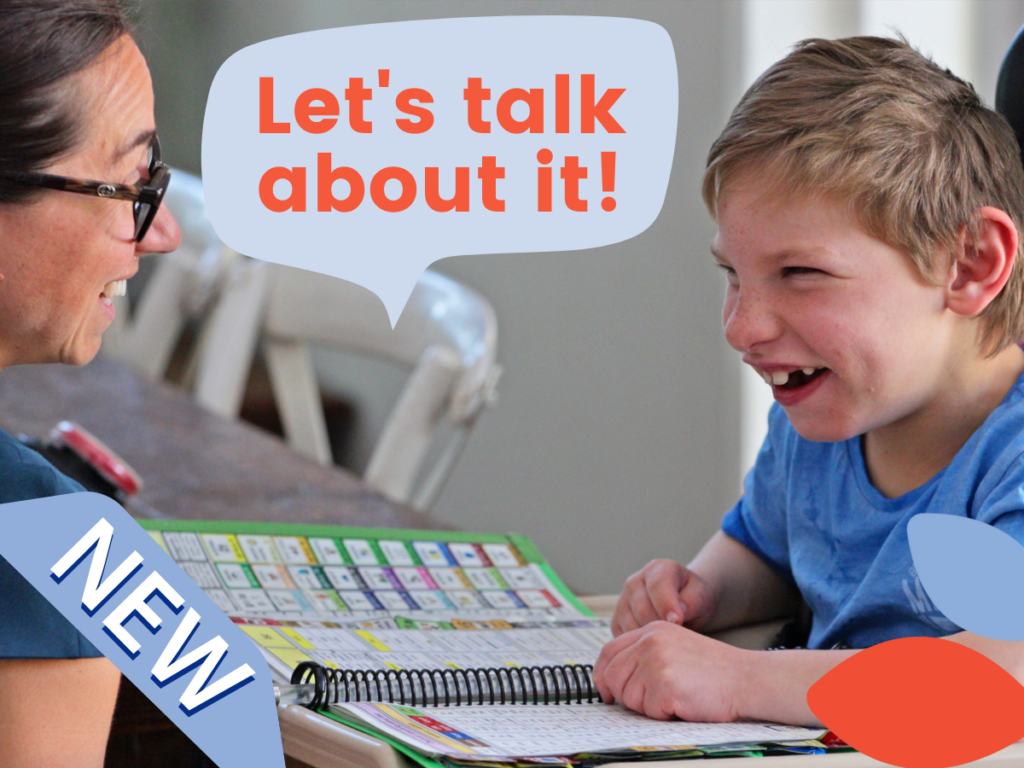
Talking About the Important Stuff online course
  • Home
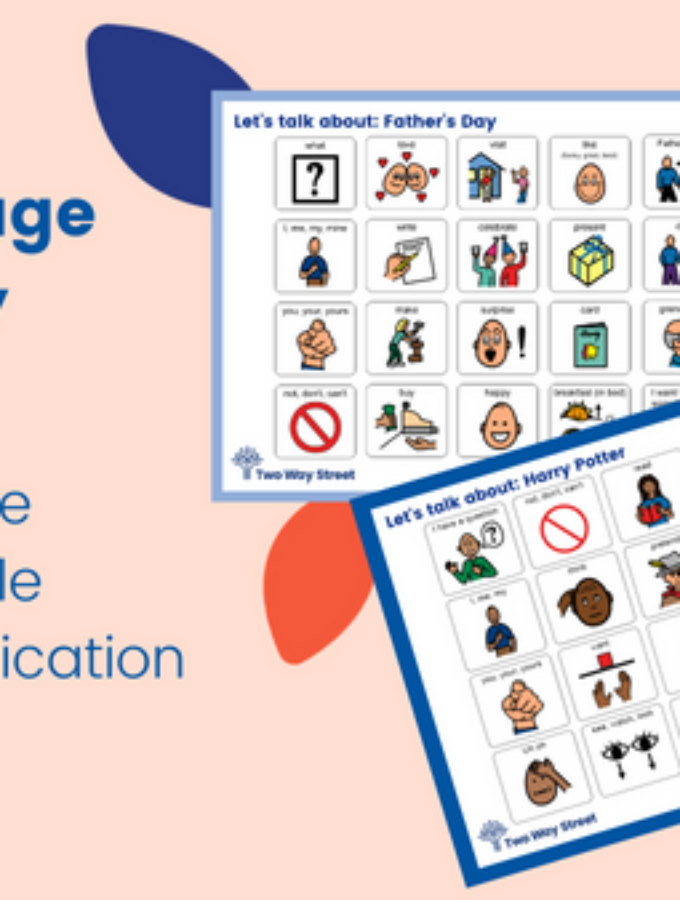
How to use an Aided Language Display (ALD)

An Aided Language Display (ALD) is a strategy to enhance communication. ALDs are usually made specifically for a situation or activity. They can be used receptively or expressively. When using an ALD receptively, pointing to the symbols adds information as you talk to someone so they are better able to understand you. When it’s used expressively, you offer the ALD to someone who may benefit from symbols to augment their communication and they could use it as they talk to you.

Usually, an ALD is used both receptively and expressively during a conversation, and quite often this is in conjunction with a person’s communication system. If the person doesn’t have a communication system with them, or if they mostly communicate with speech, sign or body language, the ALD can be a great way to enhance messages specific to the situation or activity.

To use the ALD, hold it where the person can see it. Ensure the ALD is clearly visible and available, or offer it to people as they approach. Point to the symbols as you say your message, and say aloud their message when they point to the symbols. If someone is using the ALD expressively, show them that you’re listening and use the symbols on the ALD during your response. People can choose not to use the ALD. Always honour the individual’s preferences.

Watch the video for more tips on how to use an ALD

  • Home
Representation Matters

Why an accurate representation of differences in our world matters, especially to people living with disability.

If you’re a white, middle-class male or female living without disability, you won’t need to look far to find someone you can relate to in the media. People just like you are on TV, in movies and can be seen on the pages of catalogues and magazines. 

Yet, if you’re living with a communication difficulty, or any type of disability for that matter, you’d be hard pressed to find relatable characters on your favourite media outlet. And when you consider that 4.4 million people in Australia live with disability, there’s a huge gap. That’s 18% of our population, or 1 in 6 people, unrepresented. It’s definitely time for a change.

Media is a powerful creator of perceptions. And it can also be used to create the cultural change that people living with disability would love to see. 

What happens when perceptions create your reality?

Our very own Communication Access Consultant, Margie Charlesworth, lives with Cerebral Palsy and has a communication difficulty. She uses her natural speech to communicate and also uses AAC when creating videos or presenting at conferences and to businesses looking to increase their communication accessibility. She is one of the smartest, funniest, most driven people you will ever meet and a great work mate to everyone at Two Way Street. And yet, Margie faces all kinds of perceptions around her ability to communicate. People STILL finish her sentences for her ‘to help’. And she goes from being respected for her knowledge and experience one minute, to being infantised and called a ‘good girl’ the next. 

In one of her ‘Street Talk’ moments, Margie explained how it feels to have people finish her sentences. “Finishing my sentences implies many things. It implies that the person who I am communicating with can read my mind, or that I can’t communicate my own messages. It also implies that I have difficulty expressing myself or trouble figuring out how to say it myself. And finally, it implies that people would rather not listen to my voice…” 

Imagine if Margie’s experiences were depicted somewhat realistically in the media! Those assumptions of Margie not being able to get her message across, or not being mature due to her communication difficulty wouldn’t exist. A person’s disability is an important part of their identity and is something we would love to see normalised in media representation.

This is what happens when someone dares to challenge the ‘norm’.

We’ve seen Target Australia using a model in a wheelchair to advertise kids clothing. Was that the first time a child in a wheelchair rolling through Target saw someone like them on an in-store advertisement? Potentially, yes!

We’ve just seen Disney release a remake of The Little Mermaid featuring a non-caucasion Ariel played by African American actress and singer, Halle Bailey. Reactions from little girls seeing their all-time favourite mermaid as someone they can relate to, again maybe for the first time, made the internet explode.

Our team was just as excited to see Val Kilmer using AAC in the Top Gun 2022 sequel, Maverick. In the movie, Iceman’s battle with throat cancer rendered him unable to speak without causing pain (emanating a little of what was going on for Val Kilmer in real life). He is seen typing sentences and pointing to his screen to get his message across. 

It’s this type of representation that needs to be included in mainstream media more. The every-day lives of people, all people, as valued members of society. This is why inclusion is important and representation matters. 

The many ways we can achieve representation.

Representation can also be achieved through communication modes. We have all become very familiar with the sign language interpreters during community announcements and emergency services briefings. Imagine if other modes of communication were as prevalent. Imagine if people who use modes other than mouth speech to communicate, could see their mode of communication used in advertising, signage and information media. 

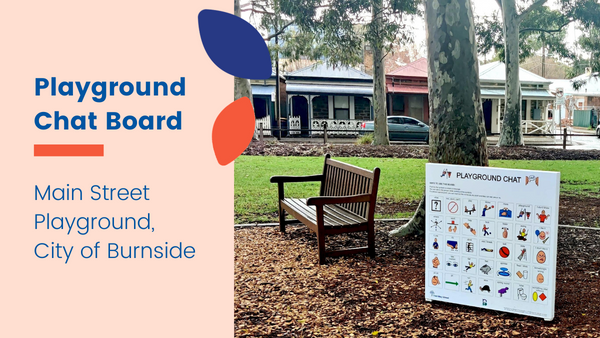
We work with a range of agencies to create signage that is not only useful for people who need the symbols to communicate, but also represent this mode of communication within the community. Our playground communication boards are a great example. We’ve also been busy creating beautiful products, like our AAC cushion covers, to ensure that symbolic communication is seen and valued around the home. And we have more to come, so if you haven’t already, join us over on Facebook and LinkedIn to stay up to date.

We’re strong believers in that world where communication brings autonomy, belonging, connection and opportunity for everyone. But we still have a long way to go…

If you are a business or organisation and would like some representation at your site, online or within your advertising, give us a call on 0434 266 237.

Do you have a communication difficulty? Are you comfortable using AAC? If you answered yes to both of those questions, then we’d love you to join us on our mission. Get in touch with Two Way Street to find out more about employment opportunities. Email [email protected] and tell us a little about yourself.
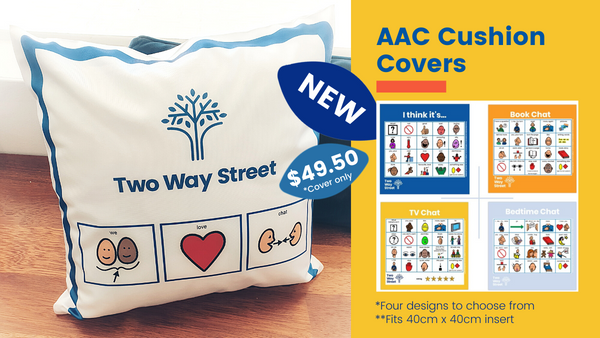
AAC Cushions
Playground Communication Board
  • Home
Talking about the important stuff

A program that builds the capacity of children with complex communication needs and their key communication partners to have conversations that will improve their emotional well-being and self-advocacy skills.

Presented by Margie Charlesworth and Janelle Sampson at the AGOSCI National Conference in Hobart on September 4-6, 2022.

Abstract:

The ‘Talking About Important Stuff’ project aims to help children with complex communication needs (CCN) and  their parents talk about important topics such as health, hopes, worries, fears and the harder subjects such as death and loss. 

The program will target early development of skills such as emotional development, well-being, and self-advocacy with a particular focus (as a pilot program) on young children and their parents. At completion of  the  project, a free online training program will be available that includes video lessons, real stories, examples and practice activities so that parents can share and teach their children how to  talk about stuff. The training program will support opportunities for children  and their parents to  learn and practice vocabulary, skills, and habits. We also hope to build on their attitudes and insights into the uniqueness and autonomy of their children.

It is important to acknowledge that this project is not about doing or expecting anything extra than the natural conversations that occur for parents and their children who do not have CCN. We simply aim to ensure that children with CCN do not miss out on this valuable learning and connection with their parents and/or people. 

This presentation  will share the progress of the project to date including a literature review and input from the project advisory committee and content  contributors, many of whom have CCN, or are  parents of children with CCN. This information will make up the key messages to be presented in the online program. 

READ NOW: Talking about the important stuff!
  • Home
ATTACHMENT DETAILS AGOSCI-presentation_Holy-Grail-of-AAC.

Creating bespoke services for people with CCN by design rather than the NDIS price guide.

Presented by Janelle Sampson at the AGOSCI National Conference in Hobart on September 4-6, 2022.

Abstract:

As providers in the disability space and in particular, augmentative and alternative communication (AAC), we know there is no magic bullet. We also know that 1:1 therapy is only part of the answer, and often the more meaningful outcomes are achieved outside of therapy sessions where  motivation and engagement is much higher. The NDIS however has structured services so that the 1:1 becomes the standard and most sought after service for therapeutic intervention. In many places, we are frequently finding that demand outweighs supply for individualised therapy, particularly when it comes to those with knowledge and experience in AAC. We are left with long wait lists for individualised services and difficulty finding funding or justifying the costs for  innovative programs that may not easily fit  within the square (or price guide).

 
At Two Way Street (TWS), we have been negotiating the NDIS (formerly Better Start and HCWA) as funding for private services for 10 years. During this time, we’ve always had our eyes on the prize that is the bigger picture beyond 1:1 services. It has taken time, patience, dedication, hard work and financial risk on many occasions to expand our services beyond just individual therapy sessions and we are still only part of the way there. 

In this presentation, the TWS team will share the  milestones and challenges we’ve encountered on our way toward our BHAG (Big Hairy Audacious Goal) for the business that includes individual services alongside capacity building and community development, while maintaining a niche focus on people with CCN at the heart.  

READ NOW: The Holy Grail of AAC Services

Two Way Street Online

28-30 The Strand
Colonel Light Gardens SA 5041

+61 (0)434 266 237
[email protected]

  • About
    • What is AAC?
    • AAC User Lecture Series
    • Our team
  • Solutions
    • Individuals and families
    • AAC professional consultation
    • PODD service
    • Schools & Early Childhood
    • Communication Access
  • Workshops and events
    • Online learning & products
    • Insights
    • Contact
    • Login
  • Privacy Policy
  • Complaints Policy
  • Child Safe Environment Policy

© Two Way Street Online 2026

Join our mailing list

  • This field is for validation purposes and should be left unchanged.
  • Fb
  • Linkedin
Login

Lost Your Password?
Register
Don't have an account? Register one!
Register an Account