Your cart is currently empty!
If you’re a white, middle-class male or female living without disability, you won’t need to look far to find someone you can relate to in the media. People just like you are on TV, in movies and can be seen on the pages of catalogues and magazines.
Yet, if you’re living with a communication difficulty, or any type of disability for that matter, you’d be hard pressed to find relatable characters on your favourite media outlet. And when you consider that 4.4 million people in Australia live with disability, there’s a huge gap. That’s 18% of our population, or 1 in 6 people, unrepresented. It’s definitely time for a change.
Media is a powerful creator of perceptions. And it can also be used to create the cultural change that people living with disability would love to see.
Our very own Communication Access Consultant, Margie Charlesworth, lives with Cerebral Palsy and has a communication difficulty. She uses her natural speech to communicate and also uses AAC when creating videos or presenting at conferences and to businesses looking to increase their communication accessibility. She is one of the smartest, funniest, most driven people you will ever meet and a great work mate to everyone at Two Way Street. And yet, Margie faces all kinds of perceptions around her ability to communicate. People STILL finish her sentences for her ‘to help’. And she goes from being respected for her knowledge and experience one minute, to being infantised and called a ‘good girl’ the next.
In one of her ‘Street Talk’ moments, Margie explained how it feels to have people finish her sentences. “Finishing my sentences implies many things. It implies that the person who I am communicating with can read my mind, or that I can’t communicate my own messages. It also implies that I have difficulty expressing myself or trouble figuring out how to say it myself. And finally, it implies that people would rather not listen to my voice…”
Imagine if Margie’s experiences were depicted somewhat realistically in the media! Those assumptions of Margie not being able to get her message across, or not being mature due to her communication difficulty wouldn’t exist. A person’s disability is an important part of their identity and is something we would love to see normalised in media representation.
We’ve seen Target Australia using a model in a wheelchair to advertise kids clothing. Was that the first time a child in a wheelchair rolling through Target saw someone like them on an in-store advertisement? Potentially, yes!
We’ve just seen Disney release a remake of The Little Mermaid featuring a non-caucasion Ariel played by African American actress and singer, Halle Bailey. Reactions from little girls seeing their all-time favourite mermaid as someone they can relate to, again maybe for the first time, made the internet explode.
Our team was just as excited to see Val Kilmer using AAC in the Top Gun 2022 sequel, Maverick. In the movie, Iceman’s battle with throat cancer rendered him unable to speak without causing pain (emanating a little of what was going on for Val Kilmer in real life). He is seen typing sentences and pointing to his screen to get his message across.
It’s this type of representation that needs to be included in mainstream media more. The every-day lives of people, all people, as valued members of society. This is why inclusion is important and representation matters.
Representation can also be achieved through communication modes. We have all become very familiar with the sign language interpreters during community announcements and emergency services briefings. Imagine if other modes of communication were as prevalent. Imagine if people who use modes other than mouth speech to communicate, could see their mode of communication used in advertising, signage and information media.
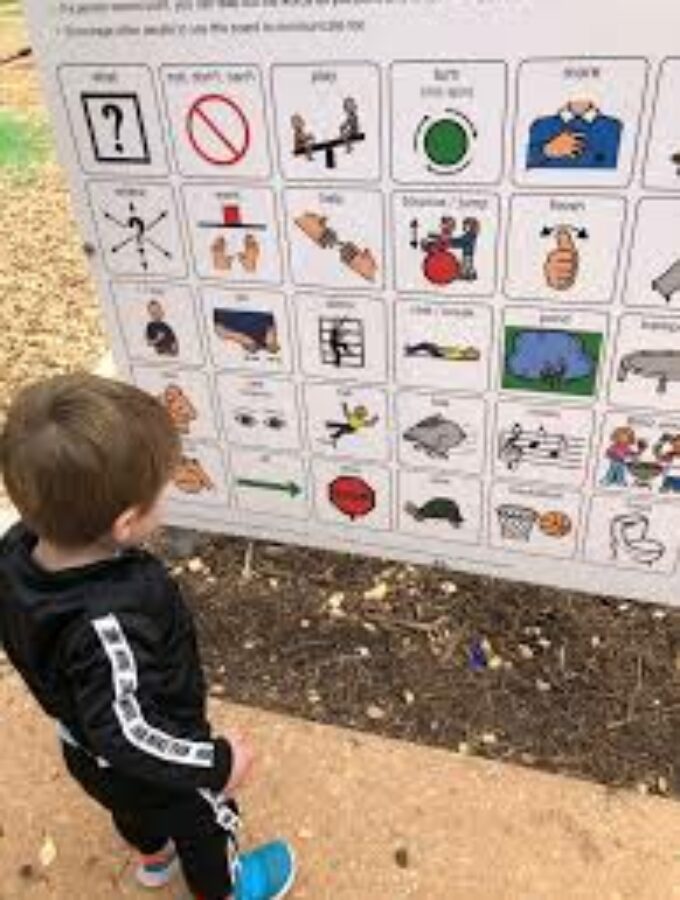
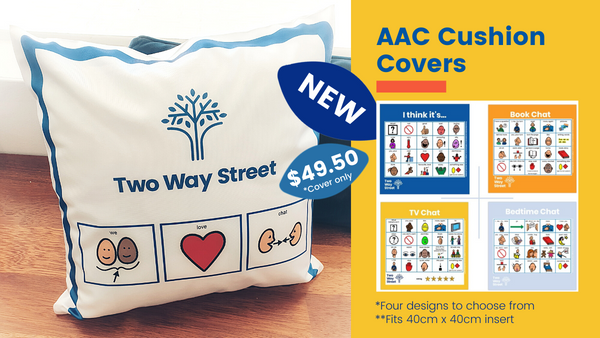
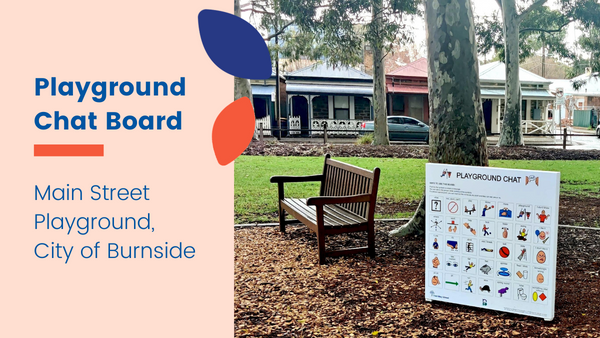
We work with a range of agencies to create signage that is not only useful for people who need the symbols to communicate, but also represent this mode of communication within the community. Our playground communication boards are a great example. We’ve also been busy creating beautiful products, like our AAC cushion covers, to ensure that symbolic communication is seen and valued around the home. And we have more to come, so if you haven’t already, join us over on Facebook and LinkedIn to stay up to date.
We’re strong believers in that world where communication brings autonomy, belonging, connection and opportunity for everyone. But we still have a long way to go…
If you are a business or organisation and would like some representation at your site, online or within your advertising, give us a call on 0434 266 237.
Do you have a communication difficulty? Are you comfortable using AAC? If you answered yes to both of those questions, then we’d love you to join us on our mission. Get in touch with Two Way Street to find out more about employment opportunities. Email [email protected] and tell us a little about yourself.
Presented by Margie Charlesworth and Janelle Sampson at the AGOSCI National Conference in Hobart on September 4-6, 2022.
Abstract:
The ‘Talking About Important Stuff’ project aims to help children with complex communication needs (CCN) and their parents talk about important topics such as health, hopes, worries, fears and the harder subjects such as death and loss.
The program will target early development of skills such as emotional development, well-being, and self-advocacy with a particular focus (as a pilot program) on young children and their parents. At completion of the project, a free online training program will be available that includes video lessons, real stories, examples and practice activities so that parents can share and teach their children how to talk about stuff. The training program will support opportunities for children and their parents to learn and practice vocabulary, skills, and habits. We also hope to build on their attitudes and insights into the uniqueness and autonomy of their children.
It is important to acknowledge that this project is not about doing or expecting anything extra than the natural conversations that occur for parents and their children who do not have CCN. We simply aim to ensure that children with CCN do not miss out on this valuable learning and connection with their parents and/or people.
This presentation will share the progress of the project to date including a literature review and input from the project advisory committee and content contributors, many of whom have CCN, or are parents of children with CCN. This information will make up the key messages to be presented in the online program.
Presented by Janelle Sampson at the AGOSCI National Conference in Hobart on September 4-6, 2022.
Abstract:
As providers in the disability space and in particular, augmentative and alternative communication (AAC), we know there is no magic bullet. We also know that 1:1 therapy is only part of the answer, and often the more meaningful outcomes are achieved outside of therapy sessions where motivation and engagement is much higher. The NDIS however has structured services so that the 1:1 becomes the standard and most sought after service for therapeutic intervention. In many places, we are frequently finding that demand outweighs supply for individualised therapy, particularly when it comes to those with knowledge and experience in AAC. We are left with long wait lists for individualised services and difficulty finding funding or justifying the costs for innovative programs that may not easily fit within the square (or price guide).
At Two Way Street (TWS), we have been negotiating the NDIS (formerly Better Start and HCWA) as funding for private services for 10 years. During this time, we’ve always had our eyes on the prize that is the bigger picture beyond 1:1 services. It has taken time, patience, dedication, hard work and financial risk on many occasions to expand our services beyond just individual therapy sessions and we are still only part of the way there.
In this presentation, the TWS team will share the milestones and challenges we’ve encountered on our way toward our BHAG (Big Hairy Audacious Goal) for the business that includes individual services alongside capacity building and community development, while maintaining a niche focus on people with CCN at the heart.
Recent changes to the National Disability Insurance Scheme (NDIS) are aiming to make things easier for participants. With these changes, come differences to the systems we’re all accustomed to. It’s important to be aware of how these changes may affect you and what you can do to be prepared.
As we move towards longer plan duration and fewer meetings with the NDIA, you will notice new terminology and processes regarding your plan.
What was previously known as a ‘plan review’ will now be called a ‘plan reassessment’. Your review date will remain as-is. To ensure participants aren’t left without services, all plans that reach their reassessment date without a reassessment being completed will be automatically extended by 12 months.
You will continue to receive Participant Check-In calls from the NDIA to discuss your wellbeing, your goals and the support you need. These calls will determine whether you need:
While likely to be towards the end of your plan duration, we’ve heard that the Participant Check-In call can happen at any time, and possibly with very little notice. This highlights the need to be prepared, with your goals and budget in mind.
You can now request a ‘plan variation’ at any time. This means, in some circumstances, you can make changes to your plan without needing to replace the entire current plan. The aim here is to speed up the process for accessing new supports.
You can read the full information shared by the NDIS on 30 June 2022. This is how the NDIS has outlined the process for changing your plan.
Here are some of our recommendations to ensure you’re prepared and won’t need to wait for access to new supports:
The work we do helps people meet their daily communication needs, and therefore, funding for most Two Way Street services comes from ‘Capacity Building Supports’ and funding for communication resources may come from the ‘Core Supports’ part of your plan. We recommend discussing which Support Budget to use to claim for services with your Support Coordinator, Plan Manager or directly with the NDIS.
Key points to remember:
It can be frustrating when things change and just knowing where to look for the right information can be half the battle. We hope this article has helped with your next steps to ensure successful changes to your plan at your next variation or reassessment.
We’re here to be your teacher, your ally and your cheer squad – even for the maze that is the NDIS. Please reach out if you need any further information on accessing the resources and services you need from us.
We share and we listen. It’s a Two Way Street.
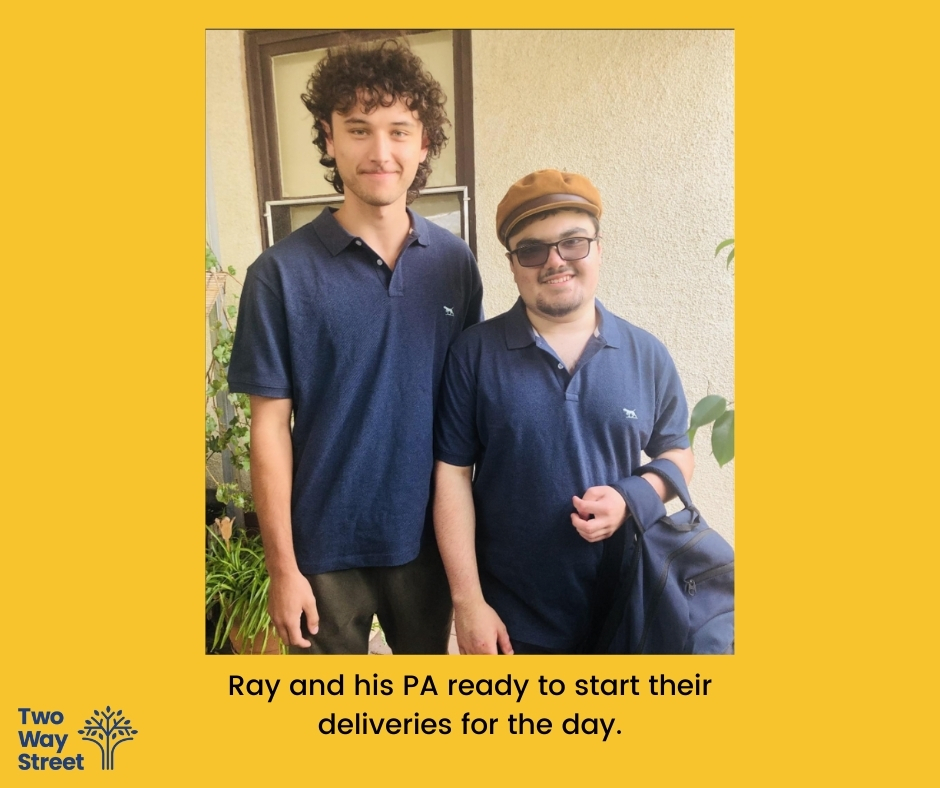
In 2020, Two Way Street client Reagan started a small courier business. Affectionately known as ‘Ray’ amongst friends and family, Reagan’s business was cleverly named ‘DeliveRay’. Reagan is a fun-loving young man who is a big fan of long walks, chilling out watching YouTube and visiting the RSPCA with his Day Options program. Reagan communicates using body language, vocalisations, some key word sign and the Proloquo2Go application on an iPad. Proloquo2Go is a symbol based Augmentative and Alternative Communication (AAC) app for iOS devices. You can find out more about Proloquo2Go via the Assistiveware website here.
The idea for Reagan’s business started when Reagan’s family heard about the Community Living Project (CLP). A family friend had recently started a micro enterprise business with support from CLP. Reagan, his family, a team of volunteers and the Community Living Project met, created goals and a business plan. From there, a board member gave the project to his students, using their design brief to create a business logo. Following this, the family hired Henry, a Personal Assistant (PA). Henry went shopping for a uniform with Reagan and had an embroidery studio sew the logo on their shirts. Reagan’s mum created a flyer and visual supports for Reagan to assist with his new routine. Reagan’s long-term support worker Indianna also assisted in this process.
Reagan and his PA deliver goods every Friday to local businesses. This started with a hot cross bun delivery to a workplace and expanded from there. Reagan communicates using his iPad with Proloquo2Go, to interact with the community and form relationships with clients. Reagan greets staff/customers, introduces Henry (PA) and himself and shares information about DeliveRay’s Services by means of words and messages stored on his communication device. The flow on effect of this, has meant Reagan now greets people with greater independence during social outings. Henry has reported that people have been in awe of Reagan’s use of AAC and how positive it has been in sharing other forms of communication with people. Reagan recently commented that working with support worker Henry makes him feel “happy” and that his favourite part is saying “good morning” to his customers.
Reagan’s mum Chrissa and dad Garry recently shared that “Reagan is now at the stage where he eagerly gets up on a Friday, with a sense of purpose, puts on his uniform, then checks his morning schedule and marks off what he needs for work. His PA reports back how super positive Reagan is during his interactions with the community and how proficient he is becoming using Proloquo2Go. As Reagan delivers on a Friday, every afternoon ends with Reagan and Henry having lunch together…usually at a pub. We love that Reagan and Henry have built a strong relationship and work well as a team and Reagan has work goals, creating a positive place in our community. Henry has also demonstrated a strong willingness to learn how to use Proloquo2Go and support Reagan”.
In 2021, Reagan and his family relocated meaning DeliveRay is still operating but on a smaller scale. Reagan and his team are now exploring new opportunities for his business. Well done to Reagan and his fantastic team, you are paving the way for people who use AAC in our community!

Don’t forget though that Communication is a Two Way Street.
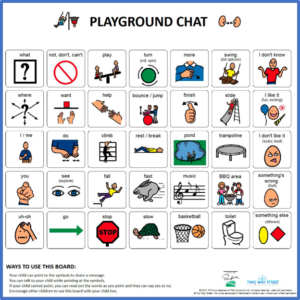
A playground board is a wonderful tool for accessibility, but it’s only good if it gets used. Otherwise it’s just a nice decoration. We decided to put together some extra information and tips to make playground boards even better!
What are they?
| Beginner (point to 1 or both of the symbols for the words in blue) then just say the other words. | More advanced You can show them how to combine words on the board. (point to the symbols for the words in blue) then just say the other words. |
| Talk about what they did or want to do | |
| I bounced on the trampoline | I bounced on the trampoline |
| I want to go on the slide | I want to go on the slide |
| We had a BBQ. | We (I/me and you) had a BBQ. |
| Can you play the music | Can you play the music |
| Ask a parent or friend to watch them | |
| I (me) can do it (watch me) | I can do it. |
| Can you see me? (Look! ) | Can you see me? (Look!) |
| Let’s go basketball. | Let’s (you, me) go basketball. |
| I want you to look/(see). | I want you to look/(see). |
| Ask a question about something | |
| Where is the slide? | Where is the slide? |
| What do I do on this? | What do I do on this? |
| Uh-oh. I don’t know how to climb up. | Uh-oh. I don’t know how to climb up. |
| Can you help? | Can you help? |
| Direct others | |
| Can you bounce me? | Can you bounce me? |
| Stop the swing. I don’t like it. | Stop the swing. I don’t like it. |
| Can you help me go to the pond? | Can you help me go to the pond? |
| Can you push me (go) fast. | Can you push me (go) fast. |
| Tell you what they think | |
| I like it. It’s fun. | I like it. It’s fun. |
| I don’t like (it) the trampoline. It’s scary. | I don’t like (it) the trampoline. It’s scary. |
| The music is too loud. I don’t like it. | The music is too loud. I don’t like it. Stop. |
| Enhance the activity | |
| Go faster | Go faster |
| More climbing | More climbing |
| My turn again (more) | My (me) turn again (more) |
| Stop. Go. Stop. Go. | Stop. Go. Stop. Go. |
| Interact with others | |
| Do you want a turn? | Do you want a turn? |
| I’ll help you. | I’ll help you. |
| Let’s play. | Let’s (You me) play. |
| Where are you going? | Where are you going? |
| Talk about problems | |
| Uh-oh. The boy fell over. (point to boy). | Uh-oh. The boy fell (fall) over. (point to boy). |
| I’m not finished. I don’t want to go. | I’m not finished. I don’t want to go. |
| I’m tired. Something’s wrong. Rest. | I’m tired. Something’s wrong. I want a rest/break. |
| And many more…. Are there any other messages that you can think of? Please remember these are just example messages and examples of the symbols you can use to say them. It’s important to use messages that are meaningful and useful to your own situation. |

Image shows a hand drawn swing set
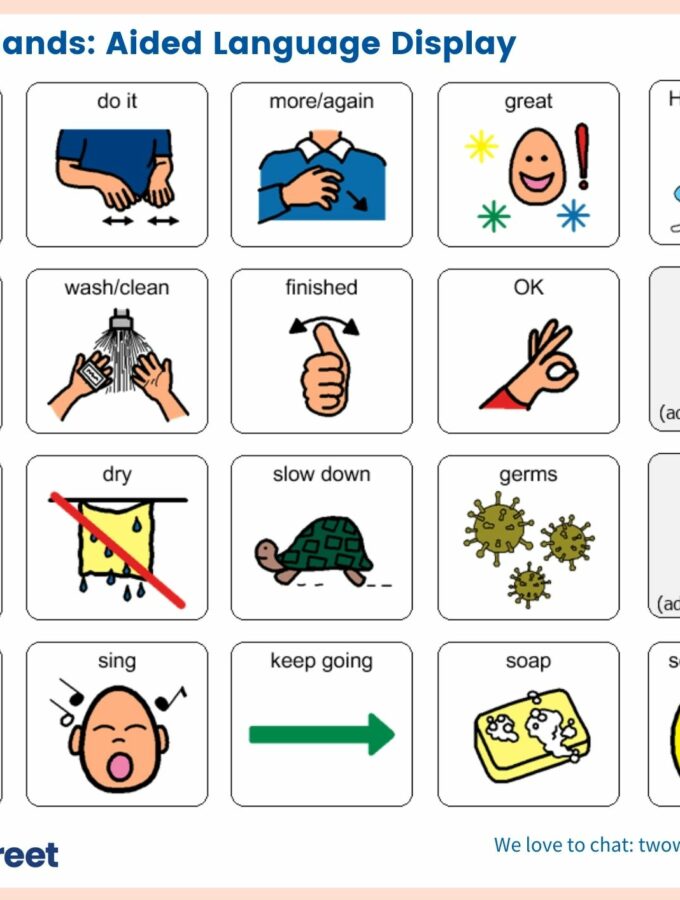
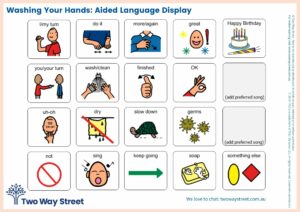
So that everyone can participate, we’ve made an aided language display to go with our now most frequent daily activity. You can download it for free at the end of this post.
There are already lots of visual supports available for the sequence of hand washing, and we’ve been using the World Health Organisation’s How To HandWash Poster but many people are adapting this. It’s impossible to list all of the options here so pick your favourite or type ‘hand washing poster’ into your browser and find one that best suits your needs.
Watch this video for the washing hands procedure in full.
Our aided language display is designed to go alongside a hand washing poster so that you can talk about it before, after and during the process. We’ve added some song choice buttons so that you can opt to sing Happy Birthday or add in a couple of your own favourite songs before you laminate the board.
Some example phrases might be:
Your turn / My turn to wash
Uh-oh – do it again
Uh-oh – slow down. Wash the germs away.
Uh-oh. More soap.
Great washing. Time to dry.
Not clean yet. Keep going.
Let’s wash and sing Happy Birthday (or insert different song).
We recommend laminating the board and implementing routine cleaning processes as well when using the board. It might seem easier not to have one that you have to keep clean, but it’s only easier if you can speak and understand spoken language!

Click here to download our free washing your hands aided language display
We also recommend reading our Talking to kids about COVID-19 resource and blog post.
“Kids worry more when they’re kept in the dark”
Rachel Ehmke, Child Mind Institute
This blog post was written in March 2020.
With the outbreak and ongoing uncertainty of the Coronavirus/COVID-19, we feel it is important to provide resources and ideas to ensure those who have communication challenges also get the information they need.
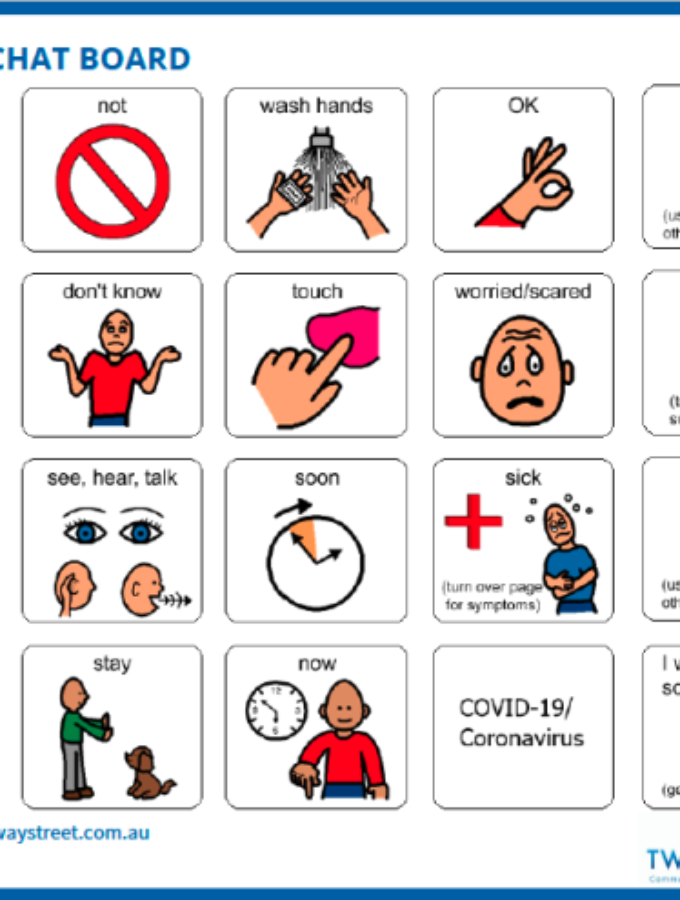
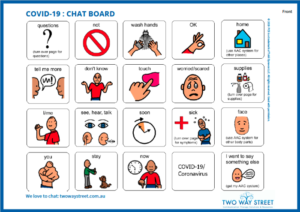
Please download our aided language display (available at the end of this article) designed specifically to support these conversations. Please note that this is a general resource and may need to be personalised or modified to suit your child/person’s vocabulary and/or layout of their system. You may need to reduce the number of items, program the vocabulary onto their device, or use partner assisted scanning rather than pointing. Please talk to your speech pathologist or AAC specialist if you have questions in relation to this process.
Give the facts:
The recommendations from experts is to buffer children from the ongoing news feed about Coronavirus, but it’s also important to give them the facts at a level that suits their age and understanding.
With the changing face of the virus, we can’t make a display that covers all of the facts. We suggest that you stay updated with credible news sites and use your child/person’s system to talk about additional facts that are not on our display. For example, this might be a good time to explore countries of the world, and talk about them. If you don’t have them, maybe add them to your system or onto the places list if using PODD.
Talk about what you can do:
“ Teaching kids what they can do to keep themselves and others safe is a positive way to make them feel empowered”
We’ve provided vocabulary to talk about the virus but more importantly, the recommendation from experts is to talk to your children about what you are doing to stay safe.
For example (words in bold are what you would model on your AAC system whilst speaking the whole phrase):
Check in and keep talking
Take an opportunity of time to talk about the virus with your child/person who uses AAC. By using the display provided and also their own system, you can help to show them the words they might need to use to ask questions or tell you things that they already know about it.
You might also model to them questions they might be thinking about.
For example:
It’s not something you need to talk about constantly, but it is important to update when needed or check in occasionally. Remember, the intention is not to scare your child/person into panic, but it is to acknowledge that they are likely hearing people talk about this virus. Maybe on the radio, people at school (students or staff), or within your home. Just because you are not talking to them, it doesn’t mean they are not hearing things. The power and control for them (and for all of us) is in asking questions and talking about it.
Through conversation we learn more and gain the information we need to feel in control.

Aided language display for augmentative and alternative communication AAC to talk about Coronavirus or COVID-19
Download our free COVID-19 aided language display
There are 2 pages to the ALD as it is intended to be a double-sided board. Printing each page and laminating them together is the most robust method for regular use.
Suggestions and information in this blog post are based on the following website information: